

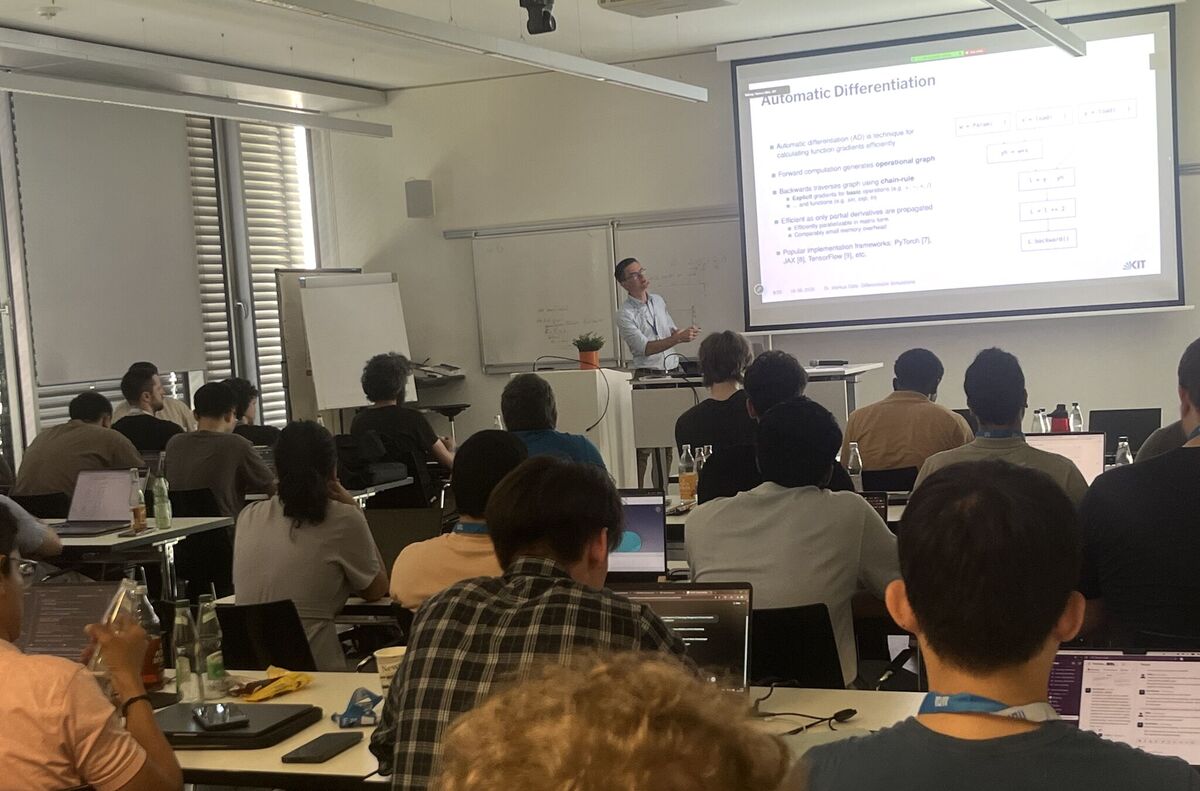
Markus Götz delivered a session at the Summer School on HPC Driving AI located at TUM Campus Heilbronn on Differentiable Simulations, an emerging approach that combines the strengths of physics-based modelling with modern machine learning techniques. The lecture explored how differentiable simulations bridge traditional first-principles models—widely used in engineering, fluid dynamics, materials science, and energy systems—with AI-driven surrogate models that enable faster prediction, optimisation, and control. By making simulations differentiable end-to-end, researchers can calibrate model parameters, solve inverse problems, develop control strategies, and integrate physical models directly into learning pipelines.
Participants were introduced to the fundamentals of differentiable simulation, including practical implementation in PyTorch, an Open Source Framework for Deep Learning, and key conceptual challenges, such as handling equations and operators that are not naturally differentiable through surrogate functions. Throughout the session, optimisation challenges in concentrating solar power plants served as a real-world example, demonstrating how differentiable simulation can support the design, operation, and control of complex energy systems. The session highlighted the growing role of differentiable modelling in advancing efficient, data-informed solutions for complex engineering and energy applications.
Contact at SCC: Dr. Markus Götz